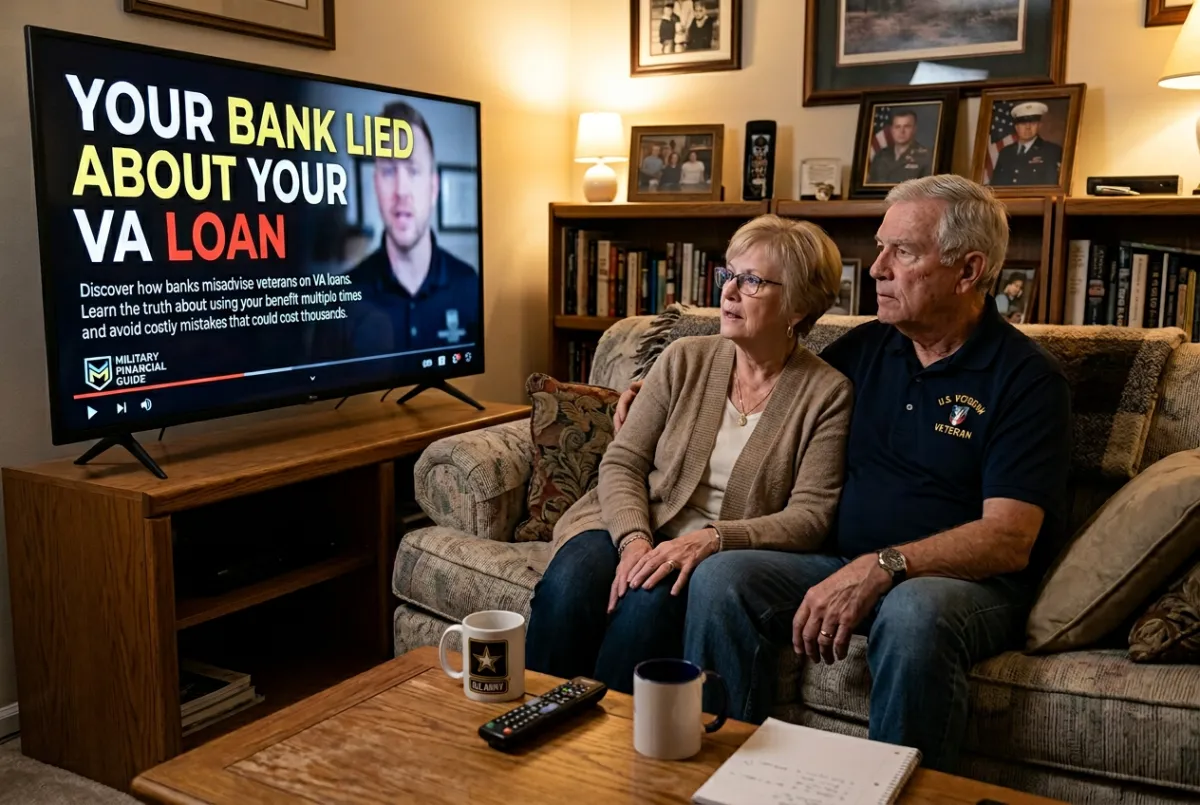
Your Bank Lied About Your VA Loan
Bad VA Loan Advice Cost This Marine $10,000
A Marine walked into a bank, told his lender he wanted to buy a duplex with his VA loan, and that lender — someone who advertised VA expertise on their website — looked him in the eye and said, "Don't waste your VA loan on a duplex. You can only use it once."
That single sentence cost that Marine roughly ten thousand dollars in unnecessary expenses. And here's the part that should make you angry: that advice was completely wrong.
If you're a veteran and a lender has ever told you to skip your VA loan and go conventional or FHA instead, there is a real chance that person cost you money, and you didn't even know it.
The Real Problem: Lenders Who Don't Understand the VA Loan Program
The problem isn't that lenders are trying to cheat veterans. Most aren't. The problem is that many lenders simply do not understand the VA loan program well enough to give you accurate advice.
They might close two or three VA loans a year. They know the basics. But when something slightly outside the box comes up — like buying a duplex, or using your benefit a second time — they default to what they know, which is conventional lending. And that default can be very expensive.
What does that mean for you? It means the person sitting across the desk might be a perfectly nice, well-meaning loan officer who genuinely believes they're helping you — and they're still wrong. That's the dangerous part.
The VA has even issued guidance to mortgage lenders urging them to maintain clean, accurate lending practices when working with veterans. The agency knows this is a problem.
What the VA Loan Actually Is (And Why It Matters)
Understanding the fundamentals of the VA loan will help you spot bad advice a mile away.
The VA loan is a mortgage benefit guaranteed by the Department of Veterans Affairs. The VA doesn't lend you the money. A private lender does — a bank, a credit union, a mortgage company. What the VA does is guarantee a portion of that loan so the lender takes on less risk.
That guarantee is called your entitlement. Think of entitlement like a promise from the government to the bank: "If this veteran can't pay, we've got your back up to a certain amount."
Because of that guarantee, lenders can offer you the loan with:
No down payment required
No monthly private mortgage insurance (PMI) — the monthly fee that conventional borrowers pay when they put less than twenty percent down. PMI protects the lender, not you, and it can run a couple hundred dollars a month on a typical home purchase.
On a VA loan, that PMI fee doesn't exist. That savings alone adds up to thousands over just a few years.
VA Loans and Multi-Unit Properties: The Lie That Cost $10,000
That Marine wanted to buy a duplex. He wanted to live in one unit and rent out the other. His lender told him the VA loan doesn't work for that.
Wrong.
The VA allows you to buy a property with up to four units — a duplex, a triplex, even a fourplex — as long as you live in one of those units as your primary residence. You move in within sixty days, you live there, and you can rent out the other units. That rental income can even help you qualify for the loan in some cases.
Buying a multi-unit property with a VA loan is one of the most powerful wealth-building strategies available to veterans. You live in one unit, rent out the others, and your tenants help pay your mortgage — all with zero down payment and no PMI.
Instead, that Marine went conventional. He had to bring a down payment to the table. He had to pay PMI every single month. And he missed out on the better terms the VA loan would have given him.
Rough math? That bad advice cost him around ten thousand dollars between the down payment he shouldn't have needed and the PMI he shouldn't have been paying. A lender who didn't understand the program steered a veteran into a more expensive loan for no reason.
The "Save Your VA Loan" Myth: You Can Use It More Than Once
Has a lender ever told you that you should "save" your VA loan for later? That you can only use it once? Because that's the second biggest piece of bad VA loan advice floating around, and it's the exact lie that Marine was told.
Your VA loan benefit does not expire. It is not a one-time-use coupon. It's a lifetime benefit. You can use it, sell that home, restore your entitlement, and use it again. And again.
And here's what many veterans don't realize: you don't even have to sell the first home.
Second-Tier Entitlement Explained
There's something called second-tier entitlement. If you still have a VA loan on one property, you may be able to get a second VA loan on a new primary residence using your remaining entitlement.
The math gets a little more specific here, but the concept is straightforward:
The VA guarantees about twenty-five percent of your loan amount.
When you have full entitlement — meaning no other VA loan is active — there is no VA program loan limit on how much you can borrow with zero down. Your approval depends on what you qualify for and what the home appraises for.
If you have partial entitlement — meaning some of your guarantee is already tied to an existing VA loan — then the conforming loan limit for your county comes into play.
The baseline conforming limit right now is $832,750. You take twenty-five percent of that number, subtract the entitlement that's already in use, and the remainder times four roughly estimates your zero-down buying power on the next home.
The exact number depends on your Certificate of Eligibility and your lender's calculation, but the point is this: you are not locked out of using your VA benefit again just because you used it before.
The Domino Effect of Bad VA Loan Advice
The real cost of bad advice isn't just one bad loan. It's the domino effect.
When that Marine was told to go conventional on the duplex, he didn't just lose money on that one transaction. He lost the rental income strategy. He lost the equity position he would have been in with zero down. He lost the ability to later use second-tier entitlement on a future home because his VA benefit was never used in the first place — it was just sitting there, collecting dust, because someone told him to "save it."
That's the pattern that plays out over and over again. A veteran gets told something incorrect early on, and it reshapes every financial decision that follows.
How to Protect Yourself: Three Steps Every Veteran Should Take
Step 1: Pull Your Certificate of Eligibility
You can do this through the VA's eBenefits portal or through VA.gov, or your lender can pull it for you. The COE shows your total entitlement, how much is currently in use, and whether you're exempt from the VA funding fee.
If a lender hasn't pulled your COE before giving you advice about whether to use your VA loan, that's a red flag. They're guessing.
Step 2: Ask Your Lender How Many VA Loans They Closed Last Year
Not "do you do VA loans," because every lender will say yes. The question is volume. A lender who closes a handful of VA loans a year is not going to know the nuances of multi-unit purchases, entitlement restoration, or second-tier calculations. You want someone who lives and breathes this program.
If the answer is less than fifty VA closings a year, keep looking.
Step 3: Know the Multi-Unit Rules Before You Walk In
If you're interested in a duplex, triplex, or fourplex, know the rules before your first meeting:
The VA allows properties with up to four residential units as long as you occupy one unit.
The property has to meet VA minimum property requirements — meaning it has to be safe, structurally sound, and each unit needs independent or individually controlled utilities.
Rental income from the other units can sometimes help you qualify, but lenders typically discount it — often counting about seventy-five percent of the market rent.
Lenders may want to see two years of landlord experience or a signed property management agreement.
If you know these details before your lender does, you're in control of the conversation.
Another Real Example: The Veteran Steered Into an FHA Loan
Here's another situation that comes up far too often. A retired Army veteran came to me after being pre-approved for an FHA loan by another lender. FHA. Not VA.
When asked why, he said his lender told him FHA was "easier" and that VA loans "take too long to close." Neither of those things is true as a blanket statement.
His credit was solid, his income was clean, and he had full VA entitlement. Here's what the two loan options looked like:
FHA loan: Required down payment, an upfront mortgage insurance premium of 1.75% of the loan amount baked into the balance, and a monthly mortgage insurance premium that on most thirty-year FHA loans lasts for the entire life of the loan.
VA loan: Zero down, zero monthly mortgage insurance, and a one-time funding fee that can be financed or waived entirely if you have a service-connected disability.
After switching him to VA, the math wasn't even close. His monthly payment dropped, his cash-to-close dropped, and his total cost over the life of the loan was dramatically lower. The Consumer Financial Protection Bureau offers tips for veterans on avoiding exactly these kinds of costly missteps.
The lender who put him in FHA wasn't malicious. They just defaulted to what they knew. And that default cost the veteran real money.
The Bottom Line on Your VA Loan Benefits
The VA loan is one of the most powerful mortgage products in existence:
No required down payment
No monthly mortgage insurance
Competitive rates
You can use it on multi-unit properties
You can use it more than once
You can even have two VA loans at the same time
But the benefit is only as good as the person helping you use it. If your lender doesn't specialize in VA lending, you are rolling the dice with your money and your future.
Across the country, only about three in ten veterans even know they can buy a home with zero down. That's not because the benefit is complicated — it's because the people who are supposed to explain it don't understand it themselves. The veteran community deserves better than guesswork.
Frequently Asked Questions
Can I really buy a duplex or multi-unit property with a VA loan?
Yes. The VA allows you to purchase a property with up to four units — a duplex, triplex, or fourplex — as long as you live in one of the units as your primary residence. You typically need to move in within sixty days of closing. Rental income from the other units may even help you qualify for the loan, though lenders usually count only about seventy-five percent of projected market rent.
Can I use my VA loan more than once?
Absolutely. Your VA loan benefit is a lifetime benefit, not a one-time-use coupon. You can use it, sell the home, restore your entitlement, and use it again. You can also use second-tier entitlement to get a second VA loan without selling your first home, as long as you have remaining entitlement and the new property will be your primary residence.
Is a VA loan better than an FHA loan for veterans?
In most cases, yes. VA loans offer zero down payment and no monthly mortgage insurance. FHA loans require a down payment, charge an upfront mortgage insurance premium of 1.75%, and include monthly mortgage insurance that typically lasts the life of a thirty-year loan. For veterans with eligible entitlement, the VA loan is almost always the less expensive option over time.
How do I know if my lender actually understands VA loans?
Ask them how many VA loans they closed last year. Every lender will say they "do" VA loans, but volume matters. A lender who closes fewer than fifty VA loans per year may not understand the nuances of entitlement reuse, second-tier calculations, or multi-unit purchases. Also, if a lender gives you advice without first pulling your Certificate of Eligibility, that's a clear red flag.
What is a Certificate of Eligibility and how do I get one?
Your Certificate of Eligibility (COE) is the document that shows your VA loan entitlement amount, how much is currently in use, and whether you qualify for a funding fee exemption. You can pull it yourself through the VA's eBenefits portal or VA.gov, or your lender can request it for you. Every conversation about your VA loan options should start with your COE in hand.
Find Out Where You Stand With Your VA Benefit
If you want help figuring out your specific entitlement situation — like how much zero-down buying power you actually have, or whether you can reuse your VA benefit on a new purchase — use the free VA entitlement calculator and resources linked below. The math is simpler than you think, and knowing your numbers puts you in control.